If you are planning to build an Accessory Dwelling Unit (ADU) in the City of Atlanta, you are probably prepared for structural drawings and zoning setbacks. But there is one hidden hurdle that catches almost every homeowner and builder off guard: The Department of Watershed Management's Post-Development Stormwater Ordinance.
Recently, we successfully navigated the City of Atlanta’s rigorous green infrastructure review for a new ADU project. The city kicked back the initial plans, asking for precise Earthwork Quantities, Green Infrastructure Sizing Charts, and Rain Garden Details.
Here is exactly how we solved the city's comments, optimized the site plan, and got the permit approved. If you are stuck in the Atlanta permitting process, this guide is for you.
## 1. Nailing the Earthwork Quantities Table
One of the first things the city reviewer will look for is your Earthwork Quantities Table. They want to know exactly how much dirt you are moving. If you leave this blank—or guess a number that is too low—they will reject the plan.
For our project (a 684 sq ft ADU), we had to calculate the exact cubic yardage for:
Cut (Excavation): Digging out the 18" foundation and the 12" deep rain garden.
**Fill (Imported Soil): **We achieved a "Balanced Site" (0 CY of fill) by reusing the excavated dirt to build the rain garden berms.
**Demolition Debris: **Clearing the topsoil and grass for the construction footprint.
Pro Tip: Don't let your earthwork numbers trigger a "Major Land Disturbance" review. By keeping our total dirt movement under 100 Cubic Yards (we calculated exactly 62 CY), we kept the project classified as a standard minor residential permit, saving thousands in erosion control review fees.
2. The Secret to the City of Atlanta Green Infrastructure Sizing Chart
The city requires you to capture and treat the first 1.0 inch of rainfall on your property. For single-family residences and ADUs, the easiest way to do this is by building a Bioretention Area (Rain Garden).
Initially, standard engineering math told us we needed a massive 130+ square foot rain garden. But here is the secret to shrinking that requirement: Use the official City of Atlanta Green Infrastructure Sizing Table (Page 25 of the SFR Guidelines).
Because the city gives you "credit" for the sponge-like qualities of amended soil, we selected an 18-inch amended soil depth. By doing this, the city's chart dropped our minimum required garden size down to just 65 square feet! We ended up proposing a 100 sq ft rain garden, which gave the city a comfortable buffer and guaranteed an easy approval.
The Power of Removing Hardscapes
During the revision process, we removed a 440 sq. ft. temporary gravel driveway from the final site plan. In Atlanta, packed gravel counts as an impervious surface. By removing it, we only had to treat the runoff from the 684 sq. ft. ADU roof, cutting our stormwater treatment requirements in half!
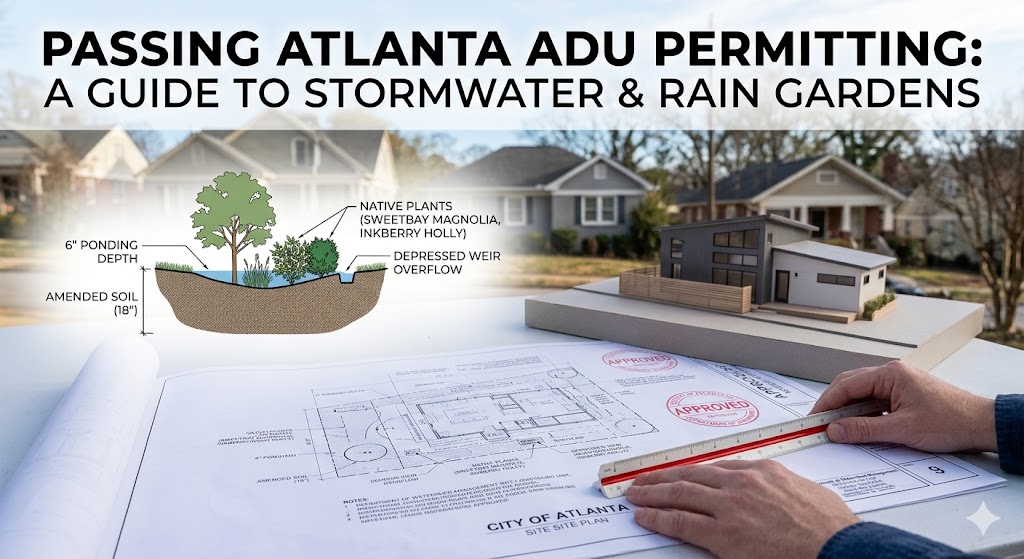
3. Designing a Code-Compliant Rain Garden Cross-Section
To get your permit stamped, you cannot just draw a circle on your site plan and label it "Rain Garden." Reviewers require a detailed cross-section specification.
To meet COA standards, your site plan detail must show:
Ponding Depth: Maximum of 6 inches.
Side Slopes: Maximum 3:1 slope for safety and stability.
Amended Soil: Minimum 18 inches deep (a mix of 1/3 compost and 2/3 topsoil).
Mulch: 2 to 3 inches of hardwood mulch (never use pine bark, as it floats away).
Setbacks: The overflow must safely discharge at least 10 feet away from property lines and foundations.
4. Selecting City-Approved Rain Garden Plants
Finally, the city will ask for a specific planting schedule. You must select plants from Appendix B of the City of Atlanta Green Infrastructure Guide that can handle both flooding and drought.
We recommend including at least one small tree to satisfy reviewers who highly encourage tree planting. Here is the exact bulletproof, native plant list we used to get our approval:
Small Tree: Sweetbay Magnolia (Magnolia virginiana)
Shrubs: Inkberry Holly (Ilex glabra) and Virginia Sweetspire (Itea virginica)
Grasses: Pink Muhly Grass (Muhlenbergia capillaris) and Switchgrass (Panicum virgatum)
## \Need Help With Your Atlanta ADU Permit?
Permitting an ADU in Atlanta doesn't have to be a nightmare, but you do need to speak the city's language when it comes to stormwater, earthwork, and green infrastructure.
If you are facing permit rejections or need help calculating your WQv (Water Quality Volume) and sizing your rain garden, you don't have to guess. Use the official calculators, follow the cross-section details strictly, and your ADU will be coming out of the ground in no time.